Now in my 80's, It seems like just yesterday that I was young, only 22, married and living on our family farm with my new bride. Yet in a way it seems like eons ago, and I wonder where the years have gone. I know that I have lived them well. I have glimpses of how it was back then and with all my hopes and dreams, but here it is ... the Autumn of my life and it catches me by surprise ... how did I get here so fast ?
Where did the years go and where did my youth go ?
I remember well seeing older people through the years and thinking that those older people were light years away from me and that autumn was so far off that I could not fathom it of imagine fully what it would be like. But here it is ... my friends are retiring and most of them are gray or even bald, they seem to move slower as I see an older person within me ... but, I do see the great change. Not like the ones that I remember who were young, and vibrant, but like me their age is beginning to show and we are now those older folks that we used to see and never thought we'd be. A nap looks better all the time, if I sit down I find myself falling asleep so easy and remembering the long hours in the fields and the rewards of brining in the harvest.
And so, now that I enter into this new season of my life unprepared for all the aches and pains and the loss of strength and the ability to go and do things that I wish I had done but never did.
But at least I Know, that though my Autumn has arrived, and I'm not sure how long this will last, this I know when its over on this earth, its not really over, a new adventure will began in Heaven.
Yes, I have regrets, there are things I wish I had done and many things that I hope to finish within this lifetime of mine.
Life goes by so fast, don't delay any longer, tell your wife you love her and do so with each of your children. I have never missed a day that I have not kissed my wife and told her that I love her as we are now going on 60 years and counting. Should the day ever come that I do not return home, I will have lived my life with my very bet friend .... my wife.
Copyright @ 2017
IF I KNEW THEN…
By Bill Henry
I’ll give you a hundred bucks if you can find a human being who has never regretted selling a great car or truck that they’ve owned, loved and sold. Just seeing one of those on the street brings instant regret. It’s not just the “backseat memories” that stem from our youth, it’s just something special, a chemistry if you will, that bring that tinge of envy when you see a great car or truck that you’ve owned.
For me, it’s that 55 Ford Crown Victoria with the glass top, or my first car…a 1951 Buick. Each of us has a list of cars we never should have sold. But, we did and for a variety of reasons…”needed the money, wrecked it, no place to store it.”
So, knowing today what we should have known then…what cars of today will be the classics and collectibles of tomorrow? Even better, what older cars that are still available are becoming hot?
In that category, older model International trucks like the 1970 Scout Terra are much in demand today. You’ll always be safe with Corvettes, Pontiac GTO’s, Chevelle SS and Ford Mustangs.
In a world where all the new cars look pretty much alike, the classics of tomorrow really stand out. And isn’t it interesting that many are modeled after the great cars of yesteryear? Take the new Chevy Camero, Dodge Magnum, the Challenger and Chargers…older styles with updated drivability. The Ford Thunderbirds of the early to mid 2000’s (pictured above) fit that description.
Even Grandpa’s Buick, like the Buick Regal GNX is a prime candidate for collectability. On the small sports car side, look at the Mazda Miata. Here’s an interesting choice…the Pontiac Aztec may make the list. As ugly as some think it is…it is distinctive, unusual and stands out in a crowd.
You probably can add your favorites to this list. Jay Leno’s advice is to always buy cars you really want to own. If it looks like a keeper to you, it probably is for others also.
So, go forth and buy…seek out and discover. But before you do that, better check with your better half, and don’t forget to price that new storage building.
Everybody Hurts
By Monty Wallis
It’s getting to be that time of the year again…spring is in the air and thoughts of getting out and enjoying life are on everybody’s minds. That’s especially true for the younger generation and even for us older-types too. Unfortunately, spring time increases the risks of celebrating life, and too often some of us don’t survive that celebration.
Here in Montana, drinking is part of our culture. Our DUI laws are weak in comparison to most states. When somebody says…”let’s go get a drink,” they’re not talking about soda. Our kids are especially vulnerable to the kegger syndrome that seems to be a right of passage in the spring time.
Talk to any law enforcement officer and they’ll tell you why they are tough on drunk drivers. Every day, they see the cost that families, friends and loved-ones pay for the actions of people who don’t seem to have any concern for anyone but themselves. It’s just too easy to have that extra beer or two, hop in the car and drive home. You see it a lot at car shows and events, and if you stop to think about it, it just isn’t worth it.
So, as the days get longer and temperatures start to rise, give some consideration to how you can make a difference in making your community a safer place. If you need a reason…click on the video below.
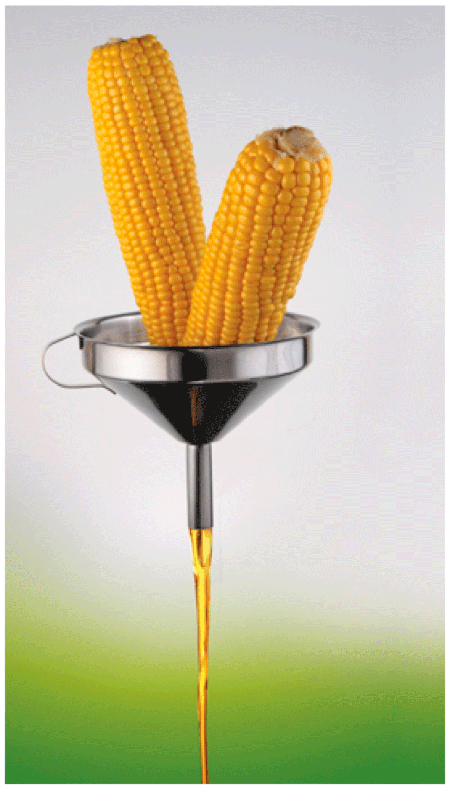
Fed a steady diet of corn, a staggering number of vintage vehicles in the United States are now suffering from clogged arteries. The culprit? Ethanol.
The issue is straightforward. Countries around the world are supplementing their gasoline with biofuels, primarily ethanol. In the United States, ethanol is distilled from corn but cellulosic ethanol can also be distilled from switchgrass, sugarcane, wood chips and other agricultural byproducts. Supplementing the petroleum-based fuel supply in this manner may be a well-intentioned effort to reduce oil dependency, but it is not cost-effective and results in severe consequences to your collector vehicle’s engine.
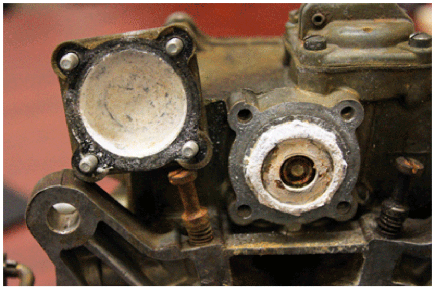
Most new vehicles are constructed with materials that resist ethanol’s potentially harmful properties when small concentrations of the biofuel are used, such as 10% ethanol by volume (E10). However, that is not the case with older cars and current high-performance specialty parts. Condensation created by this gasoline can damage engines and result in corrosion, rust, clogging and deterioration of fuel-system components.
The U.S. Congress enacted the Renewable Fuel Standard (RFS) in 2005 and then set ambitious mandates for the amount of ethanol to be blended into gasoline each year, going from 9 billion gallons in 2008 to 36 billion gallons by 2022. In order to meet the ever-growing RFS biofuel mandate, the U.S. Environmental Protection Agency (EPA) recently permitted the sale of 15% ethanol (E15) in gasoline. In the process, the EPA acknowledged that E15 poses a risk to older cars and therefore made it “illegal” to fuel pre-’01 vehicles. However, the agency is only requiring a gasoline-pump warning label to alert motorists that E15 could potentially cause equipment failure in older vehicles.
The EPA’s decision has spawned a huge battle across America. A coalition of unlikely partners has come together to fight E15. They include organizations such as the SEMA Action Network (SAN) representing collector cars and their owners, along with the boating industry, lawn-equipment manufacturers and the oil industry. It also includes the food industry (corn prices are increasing as a portion of the crop is being diverted to fuel) and environmentalists (the land, transportation and energy costs to produce ethanol undermine the benefits).
The battle’s outcome is still unknown. The EPA’s decision is being challenged before the U.S. Supreme Court. In Congress, lawmakers are considering legislation to ban E15 and also reduce the RFS mandates, the driving force behind E15. Both H.R. 875 in the U.S. House of Representatives and S. 344 in the U.S. Senate are supported by the SAN. A timeframe for resolving the debate is unclear, but the issue has become very contentious.
While it is now legal to sell E15 in America, there are only a handful of stations currently marketing the product. The infrastructure for most stations has not yet been certified for the fuel. More importantly, most automakers have not certified their vehicles for E15. Therefore, they may void the warranty for any E15-related damage.
This year, states such as Florida, Maine, Oregon and West Virginia have taken the lead in dealing with the ethanol issue on a local level. In fact, legislation to repeal the requirement that all gasoline offered for sale in the state contain a percentage of ethanol is on a fast track in Florida. As this article went to print, the bill had been approved by the Florida House and Senate and sent to the governor for his signature and enactment into law. Currently, Florida requires that all gasoline sold by a supplier, importer, blender or wholesaler contain 9%–10% ethanol, or other alternative fuel, by volume.
For auto enthusiasts in the United States, the message to lawmakers and regulators about ethanol has been clear: “Hit the brakes on E15.”
Courtesy SEMA Action Network
Super 64 Chevy By Monty Wallis
Image:
Dennis Layden Senior’s dream was to find and restore a 64 Chevy SS. Dennis, of Kenilworth, New Jersey had a Burgundy 65 Chevy when he was a teenager and always wanted to relive his dream with another vintage Chevrolet. He remembers how that Burgundy color just “popped out” and it never failed to put a smile on his face. When he found this 64 on Classiccars.com he knew he had to have it to make that dream come true.
He’s putting the car back to its original factory color. Soon the trunk, engine compartment and undercarriage will be painted as well. He credits Perfection Plus Auto Body in Kenilworth for the great paint work. Dennis says they are hard working, honest and do the best work at a reasonable price.
So far, Dennis estimates he has about 500 hours in restoration time in the car. He also has two other classic cars, but neither required restoration.
Watch CMYRYD.COM for part two of this story. We will show you the interior restoration and soon the end result of the project.
Classic Car Security Update
By Monty Wallis
One of the worst things for a classic car enthusiast to find is an empty space were your pride and joy was parked. Even though such thefts are rare, they do happen right here in hometown USA. But there are steps you can take to prevent and thwart car theft and provide an extra level of security while you store your car for the winter.
First of all, if the unthinkable really happens, it’s important to quickly report the theft to local authorities. That means you should regularly check on the vehicle if it is stored at separate location. Time is of the essence to increase your odds of recovery if your car is stolen. If you live in the city, the local Police Department is your first call. If you live outside the city limits, call your local Sheriff’s office. Make sure you have a solid description of the vehicle including license plate number, VIN, color and other outstanding features that will help identify it if spotted. Also you can hand-deliver a good color photo of the car to authorities including the Highway Patrol. They can put that photo on their shift briefing and the extra attention it will receive can only help. Then don’t forget to follow-up with your local law enforcement officials. Check-in every couple of weeks to let them know you’ve not recovered the vehicle. The same holds true when you locate your car. Contact the law enforcement agency you originally reported the theft to and quickly let them know if you recover your vehicle.
Here is another good idea… take your photo and information to your local newspaper and TV stations. With a little luck, an enterprising reporter will see a good story in your situation and you may get some press coverage because of the vintage status of your car. And don’t forget getting the message out to your local car clubs. CMYRYD is always happy to put a BOLO Alert on our website. It reaches thousands of classic car enthusiasts around the globe. Remember, the more eyes, the better the chance of recovery. That includes using Facebook and Twitter to reach the cyber generation.
But a big part of preventing car thefts depends on what you do before an incident occurs. Storing your car in a secure garage is a big step in the right direction. If possible, having an alarm system on the garage makes it even better. Many classic car insurance companies require indoor storage as part of their coverage contracts. If your classic happens to be parked outside, make sure you have some extra protection available to thwart thieves in the act. Make sure to park in a well lit area. One of cheapest devices available is “The Club” and The Club Auto Brake Lock.” You can find these simple tools at your local Wal-Mart or auto parts store. But remember, they won’t work if you don’t use them.
Also, consider using a web-cam to keep an eye on your storage area. There are several good, low cost camera systems that can easily be tied to the internet. You’ll need to have internet access at your location to make it happen, but it’s a great way to get eyes on your prize.
If cost is a concern, a simple alarm system from your local auto parts store, Radio Shack or J. C. Whitney can also do the trick for under a hundred dollars. If cost is not a consideration, consider a GPS tracking system such as LoJack. Several other manufacturers now have similar GPS units available. You can now install an OnStar system in your classic and your local Best Buy store can provide the installation and equipment.
Just one more thing, do not keep the keys in your vehicle and don’t store a spare key where it can be easily located. Make it as hard as possible for any would-be thieves to rip-off your classic. Thieves are usually lazy opportunists who want to quickly and easily do their work and get out of the areas. Your job is to make their job as tough as possible. (Updated 05/02/13)
How dry I am…
By Bill Henry
Just in case you haven’t noticed, we live in a very dry climate. Even our skin and hair are dry and this time of the year, the humidifier runs constantly. Well, this dryness takes its toll on our cars too. If you notice those little cracks along the sidewalls of your tires that run into the tread, it means just one thing… dry rot. And dry rot doesn’t just happen to your tires, anything rubber or vinyl is a prime target. These materials naturally degrade over a period of years depending on climate, temperature and humidity. How you store your vehicle can either help or delay this process. With tires, the air pressure inside your tires is also a determining factor. The common denominator in all these products is oil. As the oils in the rubber and vinyl begin to evaporate, the dry rot process begins.
So what can you do to prevent this happening to your classic car? First, drive that car often, especially during the winter storage period. Drive it at least once per month and more often if you can. Pick a nice day when there is little or no moisture on the pavement and put as many miles on the car as you can. Get the tires up to highway speed and let the rubber compounds heat up. This helps prevent dry rot and gets the oil compounds circulating in the tires. Also, keep those tires up to rated pressure. Under-inflated tires seem to crack and decompose more quickly.
Where you store your car makes a difference. Storing a car near excessive heat or in direct sunlight will speed up the deterioration process. Also, try getting your tires off the cement. Just driving onto boards can make a difference, but be sure not to use treated lumber. The chemicals in treated lumber could possibly react with the chemicals in your tires over a long period of time.
For the inside vinyl, regularly using a good vinyl or leather cleaner and sealer will help keep the moisture in place. Door panels, dash boards, seats and consoles all need to be cleaned and treated on a regular basis. Rubber seals and trim should also be treated to keep them soft and pliable.
Years ago, a doctor friend was discussing the aging process. When someone asked how he was doing…he jokingly said…he was in "a constant state of deterioration." Well, that is true of both people and cars. How well and how often we do maintenance on ourselves and our vehicles can determine how long we and the vehicle last. Another one of the doctor’s favorite sayings was…”I would rather wear out than rust out.” If exercise is great for the body then the same holds true for cars too. So the best prescription for a long life for us and for our cars may be a good dose of preventative maintenance and regular exercise.
Buying Your First Classic Car
By Bill Henry
So, the bug has bitten you and you have your eye on an old classic car sitting behind your neighbor’s garage? It looks pretty good from across the fence, but it’s tough to tell from a distance. There is a dusty old “For Sale” sign visible in the front window, but chances are the owner gave up on selling the car a long time ago. So, what is the best way to see if this car is for you? Here’s where asking the right questions is vitally important.
First things first…is this really the type of car you would like to restore, and is the vehicle in good enough shape to warrant the restoration process? Next, can you restore it to the level you would like at a price you can afford; and if you do would the vehicle’s restored value justify that expenditure? How much of the restoration can you do yourself? Is a “frame off” restoration in the cards? Do you have the tools to do what you want to do? What is the car’s actual mileage? Are there still parts readily available for this model? What is this model worth today in the condition it’s in? Do you a secure place to work on the car and store it? All are questions you need to ask and answer before you make your move.
So, you’ve answered those questions and this car still looks promising. It’s time to chat with the owner and ask more questions. Is the car still for sale? Does it still run? How long has it been sitting in the back yard? Would he be willing to let you take a close look and maybe even get it started? What’s wrong with the car?
Once you’ve done your due diligence and are still interested, you are probably ready to have a mechanic and body man take a close look. It may cost you a few bucks, but having a good mechanic start up the vehicle for the first time, may save you a ton of bucks later on. He’ll look for fluid leaks, broken or missing parts; check the compression, transmission and rear end. He can give you a quick estimate of the cost of the mechanical restoration, or what it will take to replace the motor or drive train. Then a good body man can look for rust, frame damage, previous repairs and give you a guess of paint and body work. Make sure he checks the trunk, floor and door panels.
Then it’s time to evaluate the interior. What condition are the seats, door panels and dash board? What else needs to be done to the interior?
Sound complicated? Not really…just common sense things to ask and do before you commit your wallet and tons of time and effort to a long term project. But wait… there are still a few more things to consider like the cost of ownership. Insurance for classics is fairly reasonable. But with old cars comes constant maintenance and repairs. It just seems you never get them to the level you would like. There is always something to do or buy to make them look or drive like you would like.
Still interested? Good…you will find yourself involved in a wonderful hobby and get to meet and know the nicest people.
For anyone who collects classic cars, the question is always�
�How far do I go in the restoration process?�
It�s certainly easy to spend many thousands of dollars on body
restoration, paint, engine and drive train work and accessories. But just how much do you spend and how far do
you go in the process are questions worth considering. For many of us, we don�t worry about the car�s
value after restoration. We just want a
great looking car that our friends will drool over. But for others, a more practical approach
involves the business end of the hobby. The
experts I talk to say that these questions are best answered by your wallet and
how much that car will be worth at the end of the process. You certainly could plow thousands into a
vehicle that will never be worth what you put into it. So add into the formula the following
questions:
What�s the
vehicle's collectability rating?
How much
restoration will be required?
Is there a strong
market for this car?
At what point will
I put more into the car than it�s worth?
Then there is the question of usage. For most of us, driving our classics is a big
part of the enjoyment we get from the hobby.
But if you want a perfect car that demands maximum value at sale,
chances are you will greatly limit your drive time. Let�s face it, every time we take a car out
for even a short drive, we can always see the minor nicks and abrasions that
come with usage. Chip sealed roads and
highways, dust abrasion, gravel and parking lot damage are all part of the
process.
So really, the choice comes down dreams, size of your
wallet, condition of the car, and what you expect at the end of the day. If you are a perfectionist, you�ll probably
never be completely satisfied with a car regardless of how much you put into
it. You�ll always find that tiny scratch
or imperfection. But for others, it�s
more about the process. Working on the
car with your son or daughter or grandchild on a Saturday afternoon can be
worth everything. Going for an evening
drive at sunset with that special person in your life can be a magical
experience. Driving in the Burn the
Point Parade each year can be an experience you remember all year long. Perfection means different things to
different people.
So in the end, it�s more about you than it is the car. You can enjoy a clunker if you love the
car. And if you are like most of us, our
cars are a work-in-progress. We may
never get them where we want them to be, but getting there is a big part of the
fun.
If you are one of the lucky people involved in collecting and restoring classic cars, you belong to a select part of Americana. Here is what the statistics say about you. The vast majority of classic car owners are male, but women are becoming a growing segment of the market, now amounting to 15% of all classic car owners. Men, on average spend more on their cars and are active buyers of all products and services.
The demographics of average classic car owners position them in the primary age group of 40 to 60 years of age; in a higher than average income group and participating in an active lifestyle. On average, 30% make over $80,000 per year, while 18% earn over $100,000 per year. Classic car owners are typically professional people who spend a large percentage of their disposable income of their cars and products related to automobiles. But many are mechanics, truck drivers and every day average people who just love old cars and trucks.
If you are a classic car spectator who attends cars shows and automobile related events you are a sought-after consumer. Chances are, you are male and your median age is around 38 years old, which interestingly is near the average age in our community. Your family consists of 2.3 members and you regularly travel to car related events. On average you earn between $35,000 and $75,000 per year, but 17% of you have an average income of between $75,000 and $100,000 per year. Your love of cars and racing are driving factors in your lifestyle. But whatever your age or income level, your belong to a family of great people who all enjoy classic automobiles and that love of steel, chrome, leather and rubber that is a special part of our country’s history. And we share the same feeling…they just don’t make them like that anymore.
As I�ve grown older, it seems like there are more and more
things that just don�t seem to make sense.
It could be that I thought I knew everything when I was younger, and now
the realization has finally hit me that there is an awful lot that I just don�t
get. Take gasoline prices for
example. When a barrel of crude was at a
hundred dollars, the price of gasoline increased to around $3.70 a gallon. Now, crude is selling for around eighty
dollars a barrel and the price of a gallon of gas is moving up and down but
still averaging about $3.60 to $3.70.
Just a year ago, an oil company executive explained that the law of
supply and demand controls the price of oil and gasoline. Then just last week, another oil company
executive said supply is up and demand is down, but they have nothing to do
with the price at the pump. So which is
it?
And how about that stock market? I always thought that good
economic news
made the market go up, and bad news made it go down. Now, good or bad
news doesn�t seem to matter. The market seems to be in the tank and is
going to stay there. I always knew I really didn�t understand how
the market worked but I invested anyway.
Then we saw a series of market �adjustments�
that basically took all the money I had made with my investments and
then some. My stockbroker told me to relax and not panic�that
what goes down must come up and just ride it out for the long haul.
Well, after three or four big adjustments�and
each one taking several years to recover my losses�I decided maybe I
should put
my money into something I understood�like real estate. That�s a whole
other story.
Next comes the federal government. They�ve spent more than they�ve taken in for
the last several years, but want to spend even more to �get the economy
rolling.� Why is it that I can�t spend
more than I make, but they can? Are the
rules different for government than for us?
Our Congress just went through a horrendous debate on cutting a few
billion bucks to keep the government going and then our President proposes a
new stimulus plan that will cost billions more to create �shovel ready jobs.� I think one of the presidential candidates said
it best in the last debate. His neighbor�s
two dogs have created more �shovel ready jobs� than the last multi-billion
dollar stimulus.
Radial Versus Bias-ply Tires and What Those Tire Numbers Really Mean
by Les Roth
Today’s radial tires are a wonder of modern engineering. In the late 1800’s bias-ply tires were used on bicycles. They were used on automobiles from the 1900’s to the late 1960’s. Then in 1969, radial-ply tires were introduced. The radial tire was a major improvement over the old bias–ply construction. They rolled easier and improved handling and gas mileage. The old bias-ply tires were more flexible and seemed to follow ruts in the roadway. Bias-ply tires have belts that criss-cross the tire while radial belts loop across the tire.
If you own a classic car with wheels designed for bias-ply tires, mount radial tires on those rims at your own risk. Those rims were designed for bias-ply tires only. Too many classic owners have found they lost wheel covers and even worse, had major blow-out and control issues with their car when they used radials on bias rims. Remember, radial tires are designed to be mounted only on wheels designed for radial tires.
Ever wonder what all those confusing numbers on the sidewall of your tires really mean? What you are looking at is an alphanumeric system that describes your tire and its performance characteristics. Let’s use tire size P225/70R16 100S as our example:
In the above tire size the first letter indicates the type of tire and its intended use. The “P” indicates the tire is a metric size used primarily on passenger vehicles. You can also find tires with other letter designations. They include LT (Light Truck Metric), C (Commercial), ST (Special Trailer Service) and T (Temporary Spare),
Then the numbers 225 following the first letter indicate the section width of the tire. The section width is defined as the widest point on the tire measured from sidewall-to-sidewall. For example, this tire has a 225-millimeter width. The rule here is the larger this number, the wider the tire. And remember, this number is the width of the tire in millimetres. If you are using tires larger than those specified for your car, be extra careful in measuring the available space. Raised lettering on a tire’s sidewall can make the difference between a scraped sidewall and a tight fit.
Following the slash, the number 70 shows the height of the tire as a percentage of its section width. The rule is...the lower the number, the lower the profile of the tire. Our number is 70 and that tells you the tire’s height is 70% of its section width.
In our example, the next letter is “R” which tells you the construction of the tire, which in this case is radial. Other designation types may include “D” for bias ply construction and “B” for belted tires, but most tires today are of radial design.
Next the number 16 that indicates the size of the wheel that the tire will fit. This number is in inches and in this case, this tire would be designed to fit a 16-inch wheel. Nowadays, you’ll find tire sizes starting at 13-inches going up to 18-inches. If you buy aftermarket tires wheel sizes can run up to 22-inches or larger.
Then comes the number 100 which tire manufacturers call load rating. This number indicates the approved load rating of that tire in the Load Index. The Load Index starts at 71 (761 pounds) and goes up to 110 which would be 2,337 pounds for passenger vehicles.
And finally comes the speed rating. Our tire speed rating is “S.” Speed ratings start at M (81-mph) and go up to Y (186-mph). In this case the “S” rating shows our tire would be rated for 112-mph.
People ask me when the time will come for me to just slow down and smell the roses along the way. That time will come soon enough in the future for all of us. In the meantime, I will chase my passion of Classic Cars and its role in our life that become the memories we cherish. I am a firm believer that every car has a story to tell. We will always remember the first car that we learned to drive in with fond memories. On the lighter side, you probably remember your first date and also your very first kiss in it, if only we could have that very same car back in our lives!!
Most cars in the past were equipped with a manual transmission, you learned how to shift gears and never take your arm from around your honey. Back then there were bench seats which would allow your girl to sit next to you, bucket seats were referred to as romance busters.
So the question remains, why should we ever retire when we have so much to live for and so much we feel we can contribute to the enjoyment of the old classics. To understand what I mean, take a walk among the Classic Cars at a car show with your child by your side and feel that yearning of long ago when you got your first car. The thrill you had showing it to your friends and the first ride with your girlfriend. I have had the pleasure of spending time with people that are wealthy and those who work pay check to pay check. Money, status, age, it doesn't make any difference when it comes to car talk, we are all the same. What we do in life will keep us young, what we believe in will keep us going to pursue what we love.
It was at the age of retirement I built my first street rod. Until then I had a family to raise and children to educate. When the day comes that you can afford to build your dream car it will probably be of the vintage that you grew up with. Any car will be a money pit, unlike gambling, you always have something to show for it. Family fun and the fond memories, that's what it's all about.
A Letter To Owners of the Model T Mailed June 29, 1928 Dear Sir, We're writing this letter to you today because we want to help you get your money out of your Model T. It's still as good a car as it was the day the new Model A Ford was announced and there's no need to sacrifice it. The Model T Ford is still used by more people than any other automobile. Eight million are in active service right now and many of them can be driven one, two, three and five years and even longer. Bring your car to us and let us look it over. You'll be surprised to see how little it costs to put it in top shape.
New fenders, for instance, cost from $3.50 to $5,00 each, with a labor charge of $1.00 to $2.50. Tuning up the motor and replacing the commutator case, brush and vibrator points costs only $1,00, with a small charge for material. Brake shoes can be installed and emergency brakes equalized for a labor charge of only $1,25. A labor charge of only $4.00 to $5.00 will cover the overhauling of the front axle, rebushing springs and spring perches, and straightening, aligning and adjusting wheels.
The labor charge for overhauling the average rear axle runs from $5.75 to $7.00. Grinding valves and cleaning the carbon can be done for $3.00 to $4.00.
A set of four new pistons and rings cost only about $7.00. For a labor charge of $20.00 to $25.00 you can have your motor and transmission completely overhauled. Parts are extra.
Very truly your's Your Ford Dealer, Bottineau, North Dakota
Mustang Fast Facts: From 1994 to 2011
* The fourth generation of the Ford Mustang began in 1994 and represented a reimaging of the model. The hatchback body style was dropped, leaving the coupe and convertible styles. Also, the SVT Cobra was released, powered by a 5.0 liter V-8 which produced 240 horsepower. * The 5.0 engine was discontinued in 1995. The venerable engine is retired and replaced by a new 5.8 liter V-8 for all Mustangs. New to the resurrected SVT Cobra R model in that year. The R put out an astounding 300 horsepower. Adding the Cobra R for 1995 was the start of a new range of V-8 for engines Mustangs GT's and the standard SVT Cobra. The 215 hp 4.6 liter DOHC V-8 arrived on the scene in 1966 to become Ford's most ubiquitous engines, these variants powered cars like the Crown Victoria, the Ford Explorer and the ever popular F-150. Ford then tuned the SVT Cobra V-8 to produce 305 hp. * Refinements to the 4.6 liter V-8 increased the hp to the GT to 225 hp for the 1998 model year. * The year 1999 proved to be the first major revision to the fourth generation Mustang. The framework didn't have many new changes, the body work did get an upgrade. new grill, facscias, headlights and a new hood were installed. The SVT Cobra Mustang for 1999 had changes to the engine to produce 320 hp, it was also the first Mustang to have independent rear suspension. * With it's third appearance in 2000 the SVT Cobra R added a six-speed transmission. Every gear was needed to cope with the 386 hp produced using a 5.4 liter V-8. Production was limited to just 300 units for this special addition. * In the year 2001, Ford Motor Company reflected on their past. Bullitt, the classic film made in 1988 and featured some of the greatest car races ever filmed. This film was the inspiration for the Mustang Bullitt GT model. This car featured unique side scoops on the lower part of the body. The factory suspension was tuned and the new Mustang was equipped with 17 inch wheels. * In 2002, the long lasting appeal was once again proven for the Mustang. The two largest competitors, the Pontiac Firebird and the Chevy Camaro were discontinued. The Camaro would return without the Pontiac Firebird to share the market with as it faded into the history books. * Another Mustang Classic made a comeback in 2003. The ever popular Mach 1 which had a 305 hp V-8 placed under a new shaker scoop. The SVT Cobra for 2003 raised the hp to 390 output. * 2004 was a true landmark for the Ford Motor Company which produced it's 300 millionth vehicle which was a Mustang a 40th Anniversary edition of a GT convertible. Every party must have some rain to dampen things off. this came with the word that the Dearborn, Michigan plant where the first Mustang was built in 1964 would close. *In 2005 production moved to Flat Rock, Michigan, the AutoAlliance plant This was also the year for the fifth generation Mustang. And yes, the V-6 did get bigger with displacement of 4.o liters and producing 300 hp. * A special edition Mustang called "Warriors in Pink" made it's debut. Introduced in 2007 all monies made went to the Susan G. Komen race for the Cure, a breast cancer research organization. * 2008 was the year for yet another record breaking 9 millionth Mustang GT convertible to roll off of the assembly line. * 2009 for the 45 th anniversary badge Ford offered a special glass roof.
As we all know, a VIN or Vehicle Identification Number is a
group of numbers and letters that identifies a vehicle and is unique to that
vehicle. What you may not know is before
1981, there were no standards for VIN numbers so different manufacturers all used
different formats. Most early VIN
numbers indicated the make, model and year and sequential production numbers of
the vehicle, while some gave more information such as the manufacturer�s
assembly plant, type of engine and body style.
Since 1981, VIN numbers have been a 17 digit alphanumeric number that
shows a vehicle�s country of origin, manufacturer, manufacturing division,
description, accuracy of VIN, model year, assembly plant and serial number.
Many car collectors say the most important piece of
information on the VIN is the year the car was manufactured. For others it�s important to know the
production number showing where the vehicle stands in the production run for
the year it was manufactured. But VIN
numbers are just one set of numbers that give clues to a vehicle�s origin. Law enforcement authorities use
identification numbers stamped in several different places to locate stolen
vehicles or parts. This is especially
true for high end cars including Corvettes whose owners have been surprised by
federal agents armed with Search Warrants who literally dismantled cars looking
for numbers stamped under carpets, on drive trains and on frame members.
If you want to research your classic car or truck there are
lots of sources you can use on-line. You
can go to www.buyclassiccars.com/vin.asp for a list of websites that can help you decipher the VIN numbers of a variety
of makes and models. Also, check www.edmunds.com
and click on Check Any Vehicle VIN; or the Dodge Official Site www.dodge.com
and various parts houses including Classic Industries have VIN
identification information in their catalogs.
A check on the VIN for my classic shows it is a 1974 Chevy
Nova two door Custom Coupe with a 350
Engine with a four barrel carburetor; manufactured in Van Nuys,
California; and
it was the 209,000 car out of 390,537 manufactured that year. But keep
in mind that production numbers are
not exact. Even GM or Chevy doesn�t know
the exact number of cars delivered to the public. But all in all, you
will find lots of good
information on your classic car as it was manufactured back in the day.
So take the time to check out your VIN. It may be located on a steel
plate riveted to
the left door jam on the hinge pillar or on the dash. Chances are you
will learn something new and
interesting about your classic.
For years, the overwhelming choice for classic car
collectors has been two-door automobiles.
It may have been the �look� of the particular car or just a personal
choice, but two-door cars have held the edge in popularity.
But that may be changing. It has been said that everything is cyclical,
and now the popularity cycle may be swinging back to four-door models. Lets face it, four-door cars do have their
advantages. They�re easier to get in and
out of and more convenient to do cleaning and maintenance. When new, they were the choice of families
who needed the extra room and extra doors for the kids. Maybe, it�s been the �family� label that made
the four-door models a little less cool.
But today, Obama�s Cash for Clunkers campaign and a limited
supply of classic two-door models have brought new popularity to all those four-door
versions that have been overlooked for so long. And it doesn�t seem to matter if the doors
are on a 57 Chevy or any other popular collectible, four-door cars are slowly
becoming more popular. So the next
time you see a For Sale sign on a classic four-door model, stop and take a
second look. You may like what you see.
Classic Car Insurance�How To Save Money With Specialized Coverage
Regardless
of what type of classic car you own, classic car insurance is
no-brainer for all vintage and collectible car owners. Not only does
the law require you to have liability insurance, but also your
restoration work and appreciated value can be smashed in an instant
without good insurance coverage. But do you have the right insurance
plan for your classic or is your car at risk? A recent article on the
Timeless Rides website says more than half of all classic cars are
insured by a standard insurance policies and not a collector car
insurance plan. The question to ask your agent is�.Does your standard
car insurer have a plan specifically designed for collectible cars? If
not, a company that specializes in classic car insurance may be your
answer. The question you should ask is could my classic car be
substantially under insured?
If
you check around, you will find three basic types of auto insurance,
and experts say normally two of the three are best for classic cars. The
first type is Actual Cash Value or ACV. The experts we talked to say
DO NOT USE THIS TYPE OF INSURANCE UNDER ANY CIRCUMSTANCES for your
collectible. This is the plan that standard cars are insured under, and
the standard plan is not specifically designed for classic or collector
cars. With this plan, your car is insured for its depreciated book
value, or in clear terms�its insured value is determined by what you
paid for the car, and not its collector or classic car value. Here�s an
example.�if you bought a 1968 Chevy Nova in 1976 for $3000 and you
totaled the car� an ACV package may pay you a whopping $3,000, not
today�s actual restored value of the car which could easily be ten to
twenty times more than the original purchase price. Then, if you
factor-in depreciation, get ready for a shock. Your final check from the
insurance company could make you cry.
So
what do the insurance experts recommend for classic car owners? First,
only STATED VALUE and AGREED VALUE terms of service should be
considered. In point of fact, the stated value insurance lets you place a
value on the car, allowing you to go over and above the depreciated
value. However, the stated value option does leave room for your car to
depreciate, and if you check the fine print on the contract you may
still not be fully insured for the exact stated amount. The stated
value plan also usually has deductibles. So what type of insurance is
best for your pride and joy? The Timeless Rides article says The AGREED
VALUE POLICY is the preferred choice of insurance for knowledgeable
classic car owners. Under this plan, your classic car is covered 100% up
to the agreed upon value of the car, and there are usually no
deductibles. There is also another bonus because your car does not
depreciate under the agreed value policy.
As
with anything, there are drawbacks or limitations with Agreed Value
coverage. In example, the standard plan usually has a mileage
restriction. You will find there are monthly or yearly mileage
restrictions with the average being 250 miles a month, or 2,500 miles a
year. Your insurance company may require yearly odometer readings at
renewal time. If you look hard and negotiate, it is possible to find
packages that do not include a mileage restriction.
Nearly
all policies require you to prove you have another vehicle as your
daily driver. Some policies even require one vehicle per driver in the
household. And if you intend to use your car for racing, forget it, or
work out a different type of policy with your insurer. And where you
keep or store your classic or collectible car matters to your insurance
company.
Most
policies also require classic cars to be garaged or placed in a secure
storage facility. If you want your fully restored 57 Chevy to sit the
driveway, think again. Also, what if junior wants to take your classic
ride to the prom? We�ve found that most collector car insurance
policies require the driver to be at least 25 years old. Chances are,
insurers will also do a records check to see what junior�s accident or
ticket history may be. Some companies go back a minimum of ten years.
Here
are some additional ways to save on your hard earned insurance
dollars. Many insurers will allow you to have multiple cars for the
same premium. The more classics you have the better because the premium
stays the same. If you are in the process of restoring your classic
and the car is on the rotisserie, you should be able to negotiate a
better deal with your insurance agent. Also, remember, newer model
collectible cars can be insured at classic car rates. The same mileage,
storage and driver restrictions may still apply.
So,
what information should you take from this article? Do your homework.
Talk to your insurance agent and see what specific policies he or she
has for classic or collectible cars. Then look at companies that
specialize in classics. Your regular agent or insurance company may have
a special category for these cars. More than likely, you can save up
to 50% by tailoring your coverage specifically for your own classic. In
any case, make sure you�re covered up to the real value of your car.
Insure that classic or collectible for what it�s really worth and then
periodically review your coverage and make any necessary adjustments.
Remember, restoration adds value to a car, so if you have recently
restored, or are in the process of restoring a car, look at raising your
coverage values. Even in these uncertain economic times, many classic
cars are still appreciating in value. So above all, make sure your
coverage is adequate.
If you love cars and collect classic cars in particular, it�s important to establish the true value of a car whether you are buying or selling. So where do you turn to get the information you need on how much to pay or price the value of that classic? The good news is� there are plenty of sources to help you determine the value.
If you Google the words "Classic Car Values" you�ll see several sources including truecar.com, edmunds.com, nadaguides.com/classic-cars, kbb.com (Kelly Blue Book), buyclassiccars.com, and antiquecar.com/classic-car-values.php. But if you prefer a hard copy try Black Book�s CPI (Cars of Particular Interest). It estimates the retail value of older used cars and light trucks built between 1946 and 1995, and is published bi-monthly. You can subscribe or find more information on the internet at www.BlackBookUSA.com or you can call 800-554-1026.
So how do these sources calculate average values? Primarily, the overall condition of a classic vehicle is the most important factor in determining value. Black Book for example uses three categories of value� fair, excellent and good. Many experts say classic cars should be rated in five or six separate categories. Internet writer Laura Evans in a life 123.com article says most experts agree the major categories are:
Excellent. The top car category indicating a car which is typically not driven more than a few miles per year, if at all; is in either original condition with few flaws or has been professionally restored to perfect or nearly flawless condition. These cars are extremely rare are require extensive documentation. Many buyers are willing to pay a premium for cars in this category.
Fine. Fine cars have been professionally restored and do not show wear or are originals that have weathered time and Mother Nature extremely well.
Very Good. Very good classic cars whether restored or in original condition, actually show some wear but are driven sparingly. However, these cars look good overall and function well.
Good. Classic cars in the "Good" category may need painting or minor body work, but have all of their parts and are in drivable condition. You can more easily locate cars in this category and they have a wide range of prices. Many are weekend drivers. Many completed restorations fall into this category.
Restorable. These classic cars need some level of restoration and if not drivable, can be fixed so that the cars will run� or are used as regular transportation. Most have replacement engines. These cars can be found on side streets, in backyards, old barns and sometimes in wrecking yards.
Parts Cars. Parts cars� commonly referred to as Beaters or Donors are too rusted or damaged to be fully restored and can only be used as a source for parts. A classic car may be a parts car even if the car can be driven and the value of a parts can is usually based on the estimated value of its parts.
Evans says classic autos can also be rated on a point system, which is based on a maximum of 100 points. For example, an excellent car would have a rating of 95 or more while a fine car would fall in the 90 to 95 point range with various steps falling below for each category.
Many classic cars buyers also use a collectability rating from A to D, with A being the highest rating and D the lowest. This scale is based on many factors including the number of cars originally manufactured or remaining in existence to popularity of a specific model.
There are many other factors that determine the value of any vehicle, including classics. The media can instantly increase the popularity of a car. The TV show The Dukes of Hazzard made the 1969 Dodge Charger �The General Lee� into an instant retro hit. The vintage TV show Route 66 made the Corvette into a star. Demand for a particular car or truck rises or falls and with it the value. Demand may also vary by city, state or part of the country. You may be able to buy your dream car in another state and still save money over buying the car at home.
Also, the type and amount of customization on a car will change the value. Evans says if you really want a classic car, you should take into account how much money you will have to spend to restore the custom car to its original condition before you make an offer. Or, if you want a customized car or truck, recognize that the value will be affected by the amount, type and quality of the customization.
The liquidation of large lots of cars, auctions and other availability factors can change classic car values rapidly in particular locales and areas.
So how much should you pay for that classic you�ve found? If you see the prices paid at major classic car auctions you know that the sky is the limit. But going by the condition and book value is certainly a safe way to buy that vintage car or truck. But we all know that sometimes we want that particular vehicle so much that we are willing to pay a premium to own it. Financially speaking, it may be wise to temper those personal feelings and desires and go with those tried and true established value ranges. In the end, it�s all about how much it is worth to you.
A special thanks to many dedicated Classic Car lovers who have spent countless hours and several trips to Helena to meet with our States 59th Legislature. Their goal was to eliminate the front license plates on the Classics. This proved to be a lengthy process spearheaded by Don Brocopp of Billings. The full document is very long, with this in mind I will try to condense it to a much shorter version.
A custom vehicle is termed a motor vehicle and not a motorcycle.
A car must be at least 25 years old and not to be used for general transportation like household maintenance, employment or education, etc.
This document does not include a vehicle that has been repaired or restored to its original design by replacing parts. Kit vehicle may be a prefabricated body placed on an existing frame and motor commonly called a donor car.
"Street Rod" means that a vehicle has been altered from the factory or has a body constructed from nonoriginal materials.
Registration: For a custom vehicle, street rod, kit vehicle, or specially constructed vehicle. It must be more than 30 years old and registered under 61-3-411 as a collectors item.
The $10 State of Montana ruling: The custom vehicle or street rod must have been registered prior to January 1, 2006 and can display only the rear license plate for an additional $10 fee to be deposited in the State general fund.
This was signed into law April 18, 2005 by the Governor of Montana. Click here to view a copy of the Montana Law on classics. Click the MVD logo in the upper-right corner of this article to visit their website.
Classis Car Dealerships…Are They The Place To Buy?
Around the country, we’re starting to see more car dealerships that sell and specialize in classic cars. One such dealership is Discover Classic Cars in Phoenix, Arizona. You can find their webpage at www.discoverclassiccars.net. Open for approximately five years, Discover also sells exotics and high end cars that you normally don’t see on a used car lot. They also take classic cars on consignment, with about half the cars on their lot sold that way.
A Discover spokesman says they sell between 300 and 500 cars per year and have a complete service and body shop that goes through each car checking for rust and body damage, matching numbers for original un-restored cars and general repair work. The dealership says they take any car from 1911 to 2011 but they specialize in the classic, exotic and even replica categories. A recent walk through of the dealership found a wide variety of cars including a 1925 Ford Model TT; 1997 Dodge Viper RT-10; 1967 Chevy Camero; 1955 Ford thunderbird; 1956 Desoto Firedome; 1964 Cobra Shelby replica and a nice 2008 Ford Mustang Cobra GT-500. So is buying a classic car from a dealership the way to go? For some buyers it may be the quickest and easiest way to find a certain make or model they desire. But how about price? A 1955 Ferrari 355 Tribute at Discover was listed at $36,888 while a 1967 Chevy Camero was $38,888. As with all dealerships, prices are negotiable and depend on the usual factors of condition, collectability and availability. For others, auctions, estate sales, barn finds and backyards are still the way to their next ride. It’s really up to the buyer to choose what works for him/her. The good thing about classic car dealerships is the variety of cars under at one location. It’s like a continuous classic car show at the same location. So the next time you are in Phoenix or any of the larger cities in the country, check out the classic car dealerships. You won’t find many, but chances are you’ll find one with a good selection of cars and prices.
New Federal Tax Would Tax You Based On The Number Of Miles You Drive
As if the State Gas Tax and record high prices at the pump don�t hit American drivers hard enough, the Obama administration has floated a transportation authorization bill that would require the study and implementation of a plan to tax automobile drivers based on how many miles they drive. The plan is a part of the Obama administration's Transportation Opportunities Act. News of the draft was published in the Drudge Report and story on The Hill website which follows a March Congressional Budget Office report that supported the idea of taxing drivers based on miles driven.
The CBO suggested that a vehicle miles traveled (VMT) tax could be tracked by installing electronic equipment on each car to determine how many miles were driven; then payment would be collected electronically at filling stations. Senate Budget Committee Chairman Kent Conrad (D-N.D.), has proposed taxing cars by the mile as a way to increase federal highway revenues.
The Hill article says �Obama's proposal seems to follow up on that idea in section 2218 of the draft bill. That section would create, within the Federal Highway Administration, a Surface Transportation Revenue Alternatives Office. It would be tasked with creating a "study framework that defines the functionality of a mileage-based user fee system and other systems." The draft bill says the "study framework" for the project and a public awareness communications plan should be established within two years of creating an office to oversee the project, and that field tests should begin within four years.
That �office� is one more piece to this new tax proposal. A new federal office would be created to study and implement the plan. It would be funded a total of $300 million through fiscal 2017 for the project.